This is a report on a recent adventure I played in run by Panic Pillow, based on an empire toolkit The 2nd Age we created together. I’m calling it a “materialist session” of the dialectical sort, where social processes drive a lot of what happens in the game. I can’t vouch that Panic Pillow would label it similarly, but I can speak for having this type of thing in mind when designing The 2nd Age.
Panic Pillow ran the game on a HUDless basis, meaning players don’t have access to stats or dice rolls (you can read more about it in Panic Pillow’s write up here). The 2nd Age document is also very light on rules, mainly consisting of some institutional “classes” and qualitative abilities. I’ve not been part of a session with so few explicit mechanics, and was interested to learn from the experience.
Central to The 2nd Age is the idea of character advancement being tied up with the agendas of institutions, and ultimately that of an empire. Social processes operating through the empire, such as expansionism, come to have a direct bearing on the characters. That’s the theory anyway, but I was keen to see how it worked in practice.

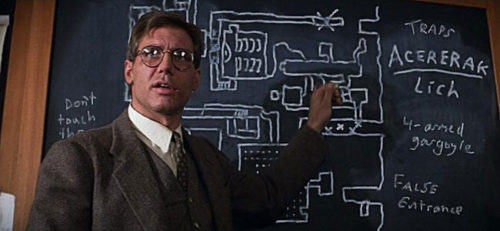
When I was at school, I wanted to be an archaeologist like Indiana Jones. Sadly, things didn’t quite work out that way. It turned out there wasn’t much call for whip wielding tomb raiders in the wider world.
From childhood to adulthood, there felt like a trend in my career options - a move from the abstract to the specific. At childhood, “what you want to be” was a vague notion of what I liked doing. Career guidance at school presented general categories of job, becoming more specific career paths at college. Then "shit gets real" with an actual job – and it doesn’t get much more specific than that.
In RPGs, there seems a similar spectrum between the abstract and specific in “what you can be”. Classically though, there is a tendency to stop at the final stage - where a character class becomes a concrete role in the game world, rather than just a career guidance template. This post ties in with a collaborative project I am undertaking with Panic Pillow, where we attempt to represent the last bit in an RPG context.
Half a year ago, Panic Pillow approached me with a suggestion for developing an idea in one of my blog posts. I’d been talking about an alternative type of character advancement based on institutions. Panic Pillow had the idea of applying this to a GLOG hack, and we decided to work on this together as a collaborative project.
Our first draft of The 2nd Age is now free to download on Itch. It’s evolved pretty far from its GLOG origins. What were class templates are now institution templates, with the emphasis on how these 12 institutions fit into the game world. It's currently geared toward a qualitative style of play, and Panic Pillow will likely produce a minimalist statement of rule to accompany this.
I’m a bit more comfortable with philosophy than I am with game design. One thing I’ve found though is that having a philosophical position can be helpful in making design decisions. Working on a collaborative project with Panic Pillow, I thought of a neat example of how a philosophical position has served me as a guide.
The part of the rules I’m working on was conceived as an Into the Odd (ItO) hack, but I wanted to treat weapons a little differently. In my first ever post, I talked about ItO as a materialist game, in that physical objects in the game world play the largest part in defining your character. But in later musings, I’ve realised there is more than one way to apply materialism to an RPG.