Saturday, October 29, 2022

HELM RPG Review

I’m only likely to review games that I get excited about on this blog. Discovering Helm made me scrap my next planned blog post and write this review instead, pausing my own game design work to fully absorb its influence.

Helm conjures a variety of ideas to me. Its resemblance to the Middle Ages is more historically grounded than most, with popelike figures prominent in its timeline. There is a smattering of Mork Borg in its sense of impending doom, but this seems more end of days as depicted in real world theology. There are Warhammer’s brutal limb-specific combat injuries. But the whole thing feels more anti-imperialist, than some sort of doom metal glorification of death and destruction.


Friday, October 14, 2022

RPG Origins: Brecht’s He Said Yes/He Said No

There are a few reasons this Brecht play stands out to me for a post on the connections between RPGs and theatre. Firstly, it’s an important transitional work in the development of participatory theatre – a form that has much in common with RPGs. Secondly, it’s very short and freely available on the web, so short that you could probably read it the time it takes to read this blog post.

It doesn’t stop there. He Said Yes/He Said No (HSY/HSN) was itself adapted from a fifteenth century work of Japanese Noh theatre. That play, The Valley-Hurling, is even shorter (about 1000 words, available here). So you could read both, and see how made Brecht made this very conservative spiritual play “participatory”. And then separately, you could consider how Brecht’s participatory form relates to RPGs.

Obviously, you may not want to read or think about any of this. But the possibility of reading about a play and the play itself in a similar timeframe seems fairly rare to me.


Sunday, September 25, 2022

Foreground Growth and Dialectical Growth

I’ve been catching up with posts on foreground growth at Bastionland.com. Foreground growth is an alternative take on character development put to work in RPGs such as Into the Odd, Electric Bastionland and Cairn. It’s a principle I'm finding dovetails nicely with a materialist approach to gaming, serving to ground character development within the gameworld.

Foreground growth seeks to subvert the abstract style of class advancement you get in D&D. Instead of a magical metamorphosis occurring in downtime, development of your character is based on events in-play. For any character ability, players should be able to relay a story from a game session that explains its origin.

There is a good illustration of this in Cairn’s FAQs, in an extended descriptive example of gameplay. An unexpected encounter with a patch of bioluminescent water leaves a character with a foot that glows in the dark. This somewhat dubious ability isn’t found in a shopping list at the back of Cairn’s rule book, but emerges in the context of an adventure.

Fear my glowing leg

Saturday, August 27, 2022

The Inverse of Cairn – Rogues as an Anti-Class

Cairn is a game by Yochai Gal that takes some of the principles I like about Into the Odd (ItO) and cranks them up a notch. I've described ItO as a materialist game in so far as the game world, via objects, plays the main role in defining your character. Cairn expands on this, making objects the basis to replicate the type of character differentiation you get in D&D.

Watching Yochai Gal’s actual play of Barrow of the Elf King showed me their commitment to objects defining characters. The adventurer’s gear is the basis for unlocking their backstory. The players are prompted to think about how certain items define them. Far more attention is paid to this, than some particularly low attribute rolls (I’ve argued for getting rid of attribute scores to emphasise this focus).

Cairn is self-described as a classless game. There is more role differentiation though than you get in ItO, as characters can effectively become “wizards” by filling their inventory slots with spell books. Unlike D&D, this doesn’t lock you into any career path. Characters can change their role in the party simply by switching out their inventories.

What then is the inverse of Cairn? Here I am going to suggest a way to define your character based on what you don’t carry. It’s empty inventory slots that influence your party role, rather than what fills them. As not having things is a pretty low bar to entry, I refer to this system as Beggar’s Choice.


Sunday, August 7, 2022

Soulslike Bastionlike/Cairnlike Games

Someone may have solved the Soulslike TTRPG already. I might have missed it due to the sheer amount out of games out there (March seeing 2 separate Soulslike jams). To narrow down my search, I’ve been looking at an overlapping subset of these games – the Soulslike Bastionlike/Cairnlike Hack. That is, games seeking to emulate Dark Souls using Into the Odd’s auto damage rules as their basis.


Sunday, July 17, 2022

When a Character Class is not a Class, but is in Fact an Institution

When I was at school, I wanted to be an archaeologist like Indiana Jones. Sadly, things didn’t quite work out that way. It turned out there wasn’t much call for whip wielding tomb raiders in the wider world. 

From childhood to adulthood, there felt like a trend in my career options - a move from the abstract to the specific. At childhood, “what you want to be” was a vague notion of what I liked doing. Career guidance at school presented general categories of job, becoming more specific career paths at college. Then "shit gets real" with an actual job – and it doesn’t get much more specific than that.


In RPGs, there seems a similar spectrum between the abstract and specific in “what you can be”. Classically though, there is a tendency to stop at the final stage - where a character class becomes a concrete role in the game world, rather than just a career guidance template. This post ties in with a collaborative project I am undertaking with Panic Pillow, where we attempt to represent the last bit in an RPG context. 

Sunday, July 10, 2022

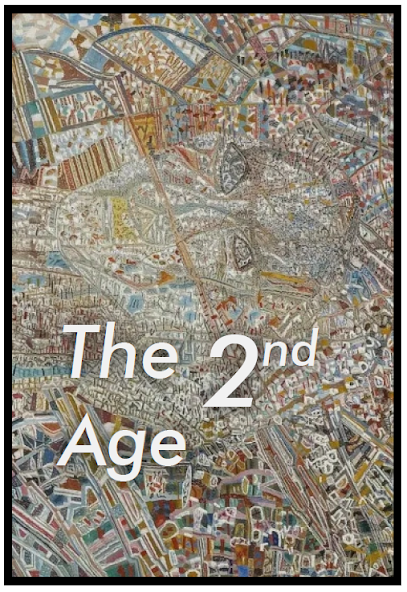
We Made a Thing: The 2nd Age Available on Itch

Half a year ago, Panic Pillow approached me with a suggestion for developing an idea in one of my blog posts. I’d been talking about an alternative type of character advancement based on institutions. Panic Pillow had the idea of applying this to a GLOG hack, and we decided to work on this together as a collaborative project.

Our first draft of The 2nd Age is now free to download on Itch. It’s evolved pretty far from its GLOG origins. What were class templates are now institution templates, with the emphasis on how these 12 institutions fit into the game world. It's currently geared toward a qualitative style of play, and Panic Pillow will likely produce a minimalist statement of rule to accompany this.  


Sunday, June 12, 2022

What Would a Materialist RPG be Like?

In previous posts, I have the habit of throwing in philosophical terms, some of which are overdue a better explanation. Materialism is a pretty common term in philosophy, but it comes in more than one variety. Here is what I mean by materialism in the context of an RPG.

Materialism in the Context of RPGs

Materialism in philosophy deals with the relationship between the material world and consciousness. Materialism tries to relate all consciousness to physical states, denying that there is any “realm of thought” separate to this.  Materialism in an RPG obviously differs from this. Firstly, we are dealing with a game world, not our real world of experience. Secondly, we are concerned not with the denial of consciousness, but a denial of the character, conceived of as something distinct from the game world.

Annihilation is a sci-fi novel, relatable to Old School Gaming through its similarity with Roadside Picnic (it was also made into a recent film starring Natalie Portman). Annihilation is not an easy book to decipher, but I take its main concern to be the annihilation of the character. This occurs as the protagonists in the novel are progressively assimilated into their physical environment, losing their sense of identity as they eventually become one with their material surroundings.


Sunday, May 22, 2022

Design Philosophies: Weapon Damage in Into the Odd

I’m a bit more comfortable with philosophy than I am with game design. One thing I’ve found though is that having a philosophical position can be helpful in making design decisions. Working on a collaborative project with Panic Pillow, I thought of a neat example of how a philosophical position has served me as a guide.

The part of the rules I’m working on was conceived as an Into the Odd (ItO) hack, but I wanted to treat weapons a little differently. In my first ever post, I talked about ItO as a materialist game, in that physical objects in the game world play the largest part in defining your character. But in later musings, I’ve realised there is more than one way to apply materialism to an RPG.

Saturday, April 23, 2022

Grounding Magic in Your Game World

I’ve been looking at ways to better ground magic in the game world. This is against it being an abstract power that turns the world into a wizard’s plaything. I’ve considered developing a somewhat grandiose “magic as science” system, with internally consistent laws. But I’ve wondered if there might be a simpler way.

Here I’m going to get down and dirty, introducing some practical interactions with the physical world to spells. This will look at individual spells in isolation, trying to make the world an interesting factor in gameplay. My thesis on the overarching laws of spell science can wait for another day.

Warning, things get dangerously close to playable content, with a link to my “materialist” take on an illusionist at the end of the post. 


Saturday, March 26, 2022

Making Spells More Scientific

There is a scene that sticks with me from childhood from the D&D cartoon series. Dungeon Master (the little bald dude) is teaching the principles of magic to the cowardly cavalier. The lesson is that summoning a spring of water to quench your thirst deprives another part of the world of water. 

This seems an important moral about maintaining balance in a self-contained system. But of course, it has nothing to do with how magic actually works in the D&D role playing game. I’ve never read a version of the create water spell that mentions its contribution to desertification. But could magic in an RPG work more like this?


Sunday, March 6, 2022

Magic as Science

This blog talks a lot about prioritising the game world in RPGs. This is partly about the world ‘pushing back’, in limiting the character’s agency to determine outcomes. Magic as a principle would seem to fly in the face of this. It’s fundamentally about manipulating the world, going against the natural limitations we face in everyday life. 

I’ve argued that 5e D&D embodies idealist poetics, which can be summed up in the principle that “thought determines being”. With magic, the wizard’s thoughts can determine being in a quite literal way – as with the Mould Earth cantrip. Take this idea too far and the whole game world becomes little more than a wizard’s malleable plaything.


Saturday, February 12, 2022

Character Advancement in 1st Edition AD&D


This is the second of two posts looking at character advancement in D&D. I previously argued that D&D takes a character-centric approach to advancement, with the game-world playing little role in determining the path of this progression. I suggested this went against the tendency in “old school” D&D (OSR) to prioritise the game world over the character. Here I will suggest ways to address this, looking at attempts made to do so in 1st edition Advanced D&D (AD&D 1e).

Last time, I singled out “Oath breaker” paladins in 5e D&D as emblematic of character classes failing to impose constraints on player agency. This subclass effectively jettisons any influence the game world has on a paladin through their religious order and deity. Basically, you get to advance whether you follow the paladin code or not. In AD&D 1e though, paladins got a bit less of free ride. This was literally so in terms of their special warhorse, which develops an “immutable enmity” towards the character if their actions cause them to lose their paladinhood (p18 Dungeon Master's Guide).